Chapter 17: August 1774
17.1 Teusday 2
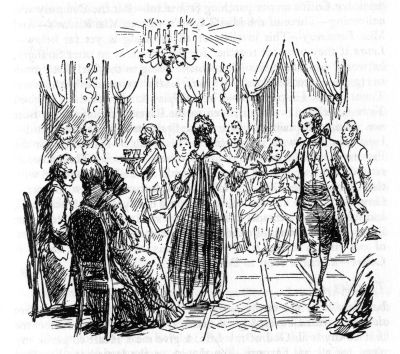
Ben & I drest ourselves pretty early with an intention to Breakfast with Colonel Tayloe, but the Servant who went with us was so slow in preparing that we breakfasted before we set out—We arrived at Colonel Tayloe's however by half after nine—The young Ladies we found in the Hall playing the Harpsichord—The morning cool with a fine Breeze from the North for I forgot to mention that about Midnight last Night a violent Gust of Blackness, Rain, & Thunder came on & gave us present Relief from the scorching Sun; there was no Dust & the riding was pleasant—The Colonel, his Lady, Miss Polly, Miss Kitty, Miss Sally, rode in their Great Coach to the Ferry—Distance about 4 miles—Ben & I on Horseback—From Colonel Tayloe's to this Ferry opposite to Hobbs's Hole the Land is levil & extremely good; Corn here looks very rank is set thick with Ears, & they are high & large, three commonly on a Stalk—Here I saw about an Acre & a half of Flax, which the people were just pulling, exceedingly out of Season—This is the only Flax I have seen since I have been in the Colony; I am told they raise much in the upper Counties—Here too is a great Marsh covered with thick high Reed—The Face of this part of the Country looks fertile, but I apprehend it is far from being healthy—We came to the Bank of the Rappahannock; it is here about 2 Miles over the Shipping on the other Side near the Town lying at Anchor look fine; no large Vessels can haul along the Wharves on account of shoal Water—There were six Ships riding in the Harbour, and a number of Schooners & smaller Vessels—Indeed, says Mrs Tayloe, Captain Dobby has forgot us. here we have been waiting for a full half hour, shall we take the Ferry Boat Colonel & cross over, & not stand any longer in the burning heat?—I was pleased not a little with the proposal tho' at the same time, I laughed with myself at Mrs Tayloe's truely Womanish impatience!—At last they are coming—The long-Boat came, well furnished with a large Awning, and rowed with four Oars—We entered the Ship about half after twelve where we were received by Captain Dobby, with every possible token of welcome—Since I have been in Virginia, my inclination, & my fixed purpose before I left home, both of which were very much assisted by a strict Attention to the instructing my little Charge, these have kept me pretty constantly, almost wholly, indeed out of that kind of Company where dissipation & Pleasure have no restraint—This entertainment of Captain Dobby's, elegant indeed, & exceeding agreeable, I consider as one among a prodigeous throng of more powerful similar Causes, of the fevers & other Disorders which are common in this Colony, & generally attributed to the Climate which is thought to be noxious & unhealthy. The Weather here indeed is remarkably variable But taking away & changing the usual & necessary Time of Rest; Violent Exercise of the Body & Spirits; with drinking great quantities of variety of Liquors, these bring on Virginia Fevers—The Beaufort is a Stately Ship; Captain Dobby had an Awning from the Stern over the Quarter quite to the Mizen-Mast, which made great Room, kept off the Sun, & yet was open on each Side to give the Air a free passage. At three we had on Board about 45 Ladies, and about 60 Gentlemen besides the Ships Crew, & Waiters Servants &c. We were not throng'd at all, & dined all at twice—I was not able to inform myself, because it seemed improper to interrupt the General pleasure, with making circumstantial inquiries concerning Individuals, & saying pray, Sir, what young Lady is that yonder in a Lute-String Gown? She seems genteel; where does her Father live? Is she a Girl of Family & Breeding? Has She any Suitors? This when one could not be out of the Inspection of the Company, would have seemed impertinent so that I did not much enlarge my Acquaintance with the Ladies, which commonly seems pleasing & desirable to me; But I took Notice of Several, & shall record my remarks—The Boats were to Start, to use the Language of Jockeys, immediately after Dinner; A Boat was anchored down the River at a Mile Distance—Captain Dobby and Captain Benson steer'd the Boats in the Race—Captain Benson had 5 Oarsmen; Captain Dobby had 6—It was Ebb-Tide—The Betts were small—& chiefly given to the Negroes who rowed—Captain Benson won the first Race—Captain Purchace offered to bett ten Dollars that with the same Boat & same Hands, only having Liberty to put a small Weight in the Stern, he would beat Captain Benson—He was taken, & came out best only half the Boats Length—About Sunset we left the Ship, & went all to Hobbs's Hole, where a Ball was agreed on—This is a small Village, with only a few Stores, & Shops, it is on a beautiful River, & has I am told commonly six, eight, & ten Ships loading before it the Crews of which enliven the Town—Mr Ritche1 Merchant; he has great influence over the People, he has great Wealth; which in these scurvy Times gives Sanction to Power; nay it seems to give countenance to Tyranny—The Ball Room—25 Ladies—40 Gentlemen—The Room very long, well-finished, airy & cool, & well-seated—two Fidlers—Mr Ritche stalk'd about the Room—He was Director, & appointed a sturdy two fisted Gentleman to open the Ball with Mrs Tayloe—He danced midling tho'. There were about six or eight married Ladies—At last Miss Ritche danced a Minuet with —— She is a tall slim Girl, dances nimble & graceful—She was Ben Carters partner—Poor Girl She has had the third Day Ague for twelve months past, and has it yet She appeared in a blue Silk Gown; her Hair was done up neat, without powder, it is very Black & Set her to good Advantage—Soon after he danced Miss Dolly Edmundson2—A Short pretty Stump of a Girl; She danced well, sung a Song with great applause, seemed to enter into the Spirit of the entertainment—A young Spark seemed to be fond of her; She seemed to be fond of him; they were both fond, & the Company saw it—He was Mr Ritche's Clerk, a limber, well dress'd, pretty-handsome Chap he was—The insinuating Rogue waited on her home, in close Hugg too, the Moment he left the Ball-Room—Miss Aphia Fantleroy danced next, the best Dancer of the whole absolutely—And the finest Girl—Her head tho' was powdered white as Snow, & crap'd in the newest Taste—She is the Copy of the goddess of Modesty—Very handsome; she seemed to be loved by all her Acquaintances, and admir'd by every Stranger, Miss McCall—Miss Ford—Miss Brokenberry3—Ball—Two of the younger Miss Ritche's—Miss Wade—They danced till half after two. Captain Ritche invited Ben & I, Colonel Tayloe & his Family with him—We got to Bed by three after a Day spent in constant Violent exercise, & drinking an unusual Quantity of Liquor; for my part with Fatigue, Heat, Liquor, Noise, Want of sleep, And the exertion of my Animal spirits, I was almost brought to believe several times that I felt a Fever fixing upon me, attended with every Symptom of the Fall Disorders—
17.2 Wednesday 3
We were call'd up to Breakfast at half after eight—We all look'd dull, pale, & haggard!—From our Beds to Breakfast—Here we must drink hot Coffee on our parching Stomachs!—But the Company was enlivening—Three of the Miss Tayloe's—Three Miss Ritche's—And Miss Fantleroy—This loveliest of all the Ring is yet far below—Laura If they were set together for the choice of an utter Stranger; he would not reflect, but in a moment spring to the Girl that I mean to regard—After Breakfast the young Ladies favoured us with several Tunes on the Harpsichord—They all play & most of them in good Taste—at eleven we went down to the River; the Ships Long Boat was waiting, Captain Purchace of the Beaufort helped us on Board—I gave the Boatswain a Pisterene for his trouble—Half a Bit for the Pasture of my Horse—We rode to Colonel Tayloe's—The Ladies all retired for a nap before Dinner. We sat in the Hall, & conversed with the Colonel a sensible, agreeable Sociable person—Miss Garrot is Governess of the Young Ladies; She too is chatty, satirical, neat, civil, had many merry remarks at Dinner, we staid til about six took our Leave, & rode Home—Found all well; gave an account of ourselves, of our entertainment, & of our Company to Mr & Mrs Carter at Coffee—& retired soon to Bed—
17.3 Thursday 4
I made out to get up by seven—A little fatigued tho'—Many are sickening with a Fever, & great numbers have the Ague—Protect me if it be thy will, God of my Life, & give me a Heart to praise thy name for all my Favours—Dined with us the Inspector—I walked through the Garden, several times banishing by solitude, as much as possible reflection on several Days past.—
17.4 Fryday 5
I have no Stockings; & I swear I wont go to the Dancing School This was the first I heard of Bob—Are Bob & Nancy gone to Mr Turberville's said the Colonel at Breakfast—Nancy is gone Sir, Bob stays at Home he has no shoes! poh! What nonsense! says the Colonel—Call Bob, & Call the Clerk—He sent Mr Randolph to the Store for a pair of Shoes, Bob he took to his Study and flogg'd severely for not having given seasonable Notice, & sent him instantly to the Dance—
17.5 Saturday 6
Last night, & this morning haizy mistty the Wind South East threatens a Rain—Transcribing my pieces, yesterday and to Day—I had a strong invitation to Dr Thompsons Fish-Feast, but the Rainy Weather hindred; I spent the Day in Quiet in my Chamber writing—Dadda Gumbey sent me a small Water-Melon.
17.6 Sunday 7
I set out for Church—It was cloudy, it Thundered in the West: But I rode on Bob was with me—We arrived at the Church & had our Saddles put into a Chariot—When a violent Gust came on—We were all in the Church; many Ladies were present—The Thunder was violent! Many discovered great Terror—Neither the Parson, nor Clerk attended—There we sat in Silence til the Storm was over, when each sallied out & splashed homewards—Mr & Mrs Carter were to have gone by Water—They had set off But saw the Cloud befor they had rowed far, & wisely returned—Towards Evening Miss Betsy Carter, Miss Polly Carter of Richmond, & Miss Turberville came over to see our Girls. Miss Betsy plays the Harpsichord extremely well, better I think than any young Lady I have seen in Virginia.
17.7 Monday 8
All once more in School—Dined with us George Lee & Mr Grubb—They spent the afternoon at the great House—After Coffee Lee rode Home—Mr Grubb staid with us all night—Dennis came into our Room to bring us a Bowl of Punch; Grubb shut the Door, and accused him of having been caught with Bett, the Dairy Girl, in the Stable last Saturday Night—Dennis seem'd in great distress, he denied the Fact tho' with great steadiness—Nelson our Boy came in with a candle—Dennis here, says Grubb to Nelson, has been accusing you, Sir, of several crimes; he says you gave him half a Bitt last Saturday Night, to stand at the Stable-Door while he with Bett—Nelson star'd—Grubb opened a huge Molls Atlas that lay in the Room; & read off their Case & indictment—The Boys seem'd crazy—We dismiss'd them when all the novelty was over, but they darted like Indians so soon as they were at liberty—We sat up til eleven—Ben drank for his Toast, Miss Julia Stockton of New Jersey; Grubb Miss Betsy Carter—I with pleasure the Rival of them all—
17.8 Teusday 9
I propose to visit Dr Jones to Day say's Mrs Carter at Breakfast—See & have the Carriage ready for me by ten o-Clock Benny—She took with her Priss, and Nancy—We have a thin School—Mr Grubb dined with us—Staid til evening, when with Ben he rode home—I finished & glad enough I feel my Latin Thesis—The Weather is now very tolerable, we had to Day a fine Shower about twelve—
17.9 Wednesday 10
All in School—Miss Fanny very much troubled with the festered Bites of Seed Ticks—Mr Stadley, whom I always see with Pleasure came towards evening—After School he gave the Girls a lesson each—About Six we have a fine Shower, with Thunder and Lightning, especiall in the evening the Lightning Sharp—
17.10 Thursday 11
Dined with us two Gentlemen Names unknown—They informed us that a Flux is in a neighbouring County, of which many die!—The Ague too is growing frequent Fanny has a fit this afternoon—I begin to be a little alarmed at the early approach of these Disorders, which I fear will be distressful here!—Through the kindness of heaven I am yet in perfect health—Mr Carter & Mr Stadley performed both on the harmonica I am charm'd with the Sounds! The melody is swelling, grave & grand! The weather vastly hot—
17.11 Fryday 12
Very hot—Sam our Barber is Seized with the Ague & Fever—Fanny is confined to her chamber with a Fever occasioned, I am apt to believe, by the inflamed bites of the Seed-Ticks, which cover her like a distinct Small Pox.—Dined with us by particular invitation, Mr Turberville's Family, and Miss Betsy Lee—The conversation at Table was on the Disorders which seem growing to be epidemical, Fevers, Agues, Fluxes—A gloomy train!—Fearing these, I keep myself at home; make my diet sparing & uniform; Use constant moderate Exercise; Drink as little Wine as possible, & when I must drink Toasts I never fail to dilute them with well with Water; I omit almost every kind of fruit; & make my time for Sleeping from Night to Night the same, Viz to Bed by ten, & rise by six invariably—I never lived so much by Rule as I do this Summer; & I am taught the Art, & have a Steady Example in Mr & Mrs Carter—Mr Stadley played on the Harpsichord & harmonica several Church Tunes & Anthems, with great propriety—
17.12 Letter of Philip V. Fithian to John Peck
Nomini Hall August 12th 1774.
"Si bene moneo[Maneo], attende."—
Sir.
I never reflect, but with secret, and peculiar pleasure, on the time when I studied in Deerfield with you, & several other pleasant Companions, under our common, & much respected instructor, Mr Green. And I acknowledge now, with a thankful heart, the many favours, which I received from your family while I was a member of it. This sense of obligation to your Family. And personal friendship for you, have excited me, when it was in my power, to introduce you to the business which I now occupy; into a family, where, if you be prudent and industrious, I am confident you will speedily acquire to yourself both Honour & Profit—But inasmuch as you are wholly a stranger to this Province; & have had little or no Experience in the business which you ar[e] shortly to enter upon; & lest, from common Fame, which is often erroneous, you shall have entertained other notions of the manners of the People here, & of your business as a Tutor, than you will find, when you come, to be actually true; I hope you will not think it vain or untimely, if I venture to lay before you some Rules for your direction which I have collected from a year's observation. I shall class what I have to say in the following order. First. I shall attempt to give you some direction for the plan of your Conduct among your neighbours, & the People in General here, so long as you sustain the character of a Tutor. Then I shall advise you concerning the rules which I think will be most profitable & convenient in the management of your little lovely charge, the School. Last of all. I shall mention several Rules for your personal conduct. I choose to proceed in the order I have laid down, as well that you may more fully & speedily recieve my mind, as that you may also the more readily select out and apply what you shall find to be most necessary.
First. When you have thought of removing, for a Time, out of the Colony in which you was born, & in which you have hitherto constantly resided, I make no doubt but you have at the same time expected to find a very considerable alteration of manners, among your new acquaintances, & some peculiarities toto Caelo different, from any you have before been accustomed to. Such a thought is natural; And you will if you come into Virginia, in much shorter time than a year, be convinced that it is just. In New-Jersey Government throughout, but especially in the Counties where you have any personal acquaintance, Gentlemen in the first rank of Dignity & Quality, of the Council, general Assembly, inferior Magistrates, Clergy-men, or independent Gentlemen, without the smallest fear of bringing any manner of reproach either on their office, or their high-born, long recorded Families associate freely & commonly with Farmers & Mechanicks tho' they be poor & industrious. Ingenuity & industry are the Strongest, & most approved recommendations to a Man in that Colony. The manners of the People seem to me, (probably I am overborn by the force of prejudice in favour of my native Soil), to bear some considerable resemblance of the manners in the ancient Spartan Common-Wealth—The Valour of its Inhabitants—was the best, & only security of that State against the enemy; & the wise laws of its renowned Legislator were the powerful Cement which kept them firm & invincible—In our Government, the laborious part of Men, who are commonly ranked in the midling or lower Class, are accounted the strenth & Honour of the Colony; & the encouragement they receive from Gentlemen in the highest stations is the spring of Industry, next to their private advantage. The Levil which is admired in New-Jersey Government, among People of every rank, arises, no doubt, from the very great division of the lands in that Province, & consequently from the near approach to an equality of Wealth amongst the Inhabitants, since it is not famous for trade. You know very well that the Lands in a small township are divided, & then again subdivided into two & three Hundred Separate, proper, creditable estates; for example Deerfield & Fairfield two Townships, or Precincts, in which you & I are tolerably well acquainted, in the former of which, are the Seats of two Judges of the Sessions; & in the latter resides one of the representatives in General Assembly for the County; But if 16000£ would purchase the whole landed estates of these three Gentlemen, who are supposed to be the most wealthy in the County, if we rate their Land at the Low Consideration of 4£ per acre, with all conveniences, each would have 4000 Acres. Now you may suppose how small a quantity many must have when two or three hundred Landholders reside in each of these small Precincts; Hence we see Gentlemen, when they are not actually engaged in the publick Service, on their farms, setting a laborious example to their Domesticks, & on the other hand we see labourers at the Tables & in the Parlours of their Betters enjoying the advantage, & honour of their society and Conversation—I do not call it an objection to this, that some few, who have no substance but work like Slaves as nec[e]ssity drives them for a few Months in the year; with the price of this Labour they visit Philadelphia; & having there acquired a fashionable Coat, & a Stock of Impudence, return home to spend the remainder of the year, in idleness & disgrace!—But you will find the tables turned the moment you enter this Colony. The very Slaves, in some families here, could not be bought under 30000£. Such amazing property, no matter how deep it is involved, blows up the owners to an imagination, which is visible in all, but in various degrees according to their respective virtue, that they are exalted as much above other Men in worth & precedency, as blind stupid fortune has made a difference in their property; excepting always the value they put upon posts of honour, & mental acquirements—For example, if you should travel through this Colony, with a well-confirmed testimonial of your having finished with Credit a Course of studies at Nassau-Hall; you would be rated, without any more questions asked, either about your family, your Estate, your business, or your intention, at 10,000£; and you might come, & go, & converse, & keep company, according to this value; & you would be dispised & slighted if yo[u] rated yourself a farthing cheaper. But when I am giving directions to you, from an expectation that you will be shortly a resident here, altho you have gone through a College Course, & for any thing I know, have never written a Libel, nor stolen a Turkey, yet I think myself in duty bound to advise you, lest some powdered Coxcomb should reproach your education, to cheapen your price about 5000£; because any young Gentleman travelling through the Colony, as I said before, is presum'd to be acquainted with Dancing, Boxing, playing the Fiddle, & Small-Sword, & Cards. Several of which you was only entering upon, when I left New-Jersey; towards the Close of last year; and if you stay here any time your Barrenness in these must be detected. I will however allow, that in the Family where you act as tutor you place yourself, according to your most accute Calculation, at a perfect equidistance between the father & the eldest Son. Or let the same distance be observed in every article of behaviour between you & the eldest Son, as there ought to be, by the latest & most approved precepts of Moral-Philosophy, between the eldest Son, & his next youngest Brother. But whenever you go from Home, where you are to act on your own footing, either to a Ball; or to a Horse-Race, or to a Cock-Fight, or to a Fish-Feast, I advise that you rate yourself very low, & if you bett at all, remember that 10,000£ in Reputation & learning does not amount to a handfull of Shillings in ready Cash!—One considerable advantage which you promise yourself by coming to this Colony is to extend the Limits of your acquaintance; this is laudable, & if you have enough of prudence & firmness, it will be of singular advantage—Yet attempt slowly & with the most Jealous Circumspection—If you fix your familiarity wrong in a single instance, you are in danger of total, if not immediate ruin—You come here, it is true, with an intention to teach, but you ought likewise to have an inclination to learn. At any rate I solemnly injoin it upon you, that you never suffer the spirit of a Pedagogue to attend you without the walls of your little Seminary. In all promiscuous Company be as silent & attentive as Decency will allow you, for you have nothing to communicate, which such company, will hear with pleasure, but you may learn many things which, in after life, will do you singular service.—In regard to Company in general, if you think it worth the while to attend to my example, I can easily instruct you in the manner of my Conduct in this respect. I commonly attend Church; and often, at the request of Gentlemen, after Service according to the custom, dine abroad on Sunday—I seldom fail, when invited by Mr or Mrs Carter, of going out with them; but I make it a point, however strongly solicited to the contrary, to return home with them too—Except in one of these cases, I seldom go out, but with a valuable variety of books I live according to Horace's direction, & love "Secretum Iter et fallentis Semita Vitae." Close retirement and a life by Stealth. The last direction I shall venture to mention on this head, is, that you abstain totally from Women. What I would have you understand from this, is, that by a train of faultless conduct in the whole course of your tutorship, you make every Lady within the Sphere of your acquaintance, who is between twelve & forty years of age, so much pleased with your person, & so fully satisfied as to your abilities in the capacity of—a Teacher; & in short, fully convinced, that, from a principle of Duty, you have, both by night & by day endeavoured to acquit yourself honourably, in the Character of a Tutor; & that, on this account, you have their free & hearty consent, without making any manner of demand upon you, either to stay longer in the County with them, which they would choose, or whenever your business calls you away, that they may not have it in their Power either by charms or Justice to detain you, & when you must leave them, have their sincere wishes & constant prayrs for Length of days & much prosperity, I therefore beg that you will attend litterally to this advice, & abstain totally from Women. But this last precaution, which I have been at some pains to dress in the plainest language, I am much inclined to think, will be wholly useless in regard to you, notwithstanding it is founded in that Honour and Equity which is on all hands allow'd to be due from one Sex to the other, & to many of your age, & Standing no doubt would be entirely salutary. Because the necessary connections which you have had with the Fair, from your Puberty upwards have been so unfavourable & ill-fated, that instead of apprehending any danger on the score of over fondness, I am fearful your rancour has grown so inveterate at length, as, not only to preserve you, in thought & practice, pure of every Fleshly foible, but has carried you so far towards the other extream, as that you will need many persuasions, when your circumstances shall seem to require it, to bring you back to a rational & manly habit of thinking & acting with respect to the Sex; which yet, after all (& eternally will continue to be, tho it is so much courted & whined after) if considered in the fullest manner, & set forth to the best advantage, never rises above its divine definition viz "The weaker Vessel." But without detaining you any longer with a matter merely depending on accident or Circumstance I pass on to the second General Head; in which "Ludis atque Jocis amotis [amatis]" I shall offer to your consideration & recommend for your practice several Rules concerning the managment of the School.
2. You will act wisely, if, from the begining, you convince all your Scholars which you may easily do, of your abilities in the several branches, which you shall profess to teach; you are not to tell them, totidem Verbis, "that you understand, perhaps as well as any man on the Continent both the Latin & Greek Classicks;" "& have gone through the usual Course in the noted College of New-Jersey, under Dr Witherspoon, so universally known & admired, where you have studied Criticism, Oratory, History, not to mention Mathematical & philosophical Studies, & dipt a good way into the French-Language, & that you have learn'd a smattering of Dancing, Cards &c. &c. &c." For Dun-p or Hack—-n or the most profound dunce in your College or School would have too much sense to pass such impudence by, & not despise and reproach it; but you may speedily & certainly make them think you a "Clever Fellow" (which is a phrase in use here for a good Scholar) if you never mention any thing before them, only what you seem to be wholly master of—This will teach them never to dispute your determination, & always to rely upon your Judgment; two things which are most essential for your peace, & their advantage. That you may avoid yourself of this with certainty I shall recommend for your practice the following method, as useful at least, if not intirely necessary. Read over carefully, the lessons in Latin & Greek, in your leisure hours, that the story & Language be fresh in your memory, when you are hearing the respective lessons; for your memory is treacherous, & I am pretty certain it would confound you if you should be accosted by a pert School-Boy, in the midst of a blunder, with "Physician heal thyself"!—You ought likewise to do this with those who are working Figures; probably you may think that because the highest Cypherer is only in decimal arithmetic, it is not there fore worth your critical attention to be looking previously into the several Sums. But you are to consider that a sum in the Square-Root, or even in the Single Rule of three direct, is to your Pupils of as great importance, as the most abstruse problem in the Mathematicks to an able artist; & you may lay this down for a Maxim, that they will reckon upon your abilities, according as they find you acquainted & expert in what they themselves are studying. If therefore you have resolution (as I do not question your ability) to carry this plan which I have laid down into execution; you will thereby convince them of the propriety of their Subordination to you, & obedience to your instructions, so that you may lead them, without any resistance, and fix them to the Study of whatever Science you think proper, in which they will rise according to their respective Capacities. I have said that you ought to strive "from the beginning" in fixing this very material article in the minds of your Scholars, Viz a Sense of your authority; for one error of Judgment, or false determination will diminish your Ability with them more than doing forty things with truth would increase your authority—They act in this case as you would do in the company of a number of Strangers—A whole evenings conversation, if it was tolerable good Sense, would perhaps make little or no impression on you; But if through hast[e] in speaking, or inattention, any one should let fall a sentence either remarkably foolish, or grossly wicked, it would be difficult if not impossible to persuade you presently that the author was not either a thick-Scull, or a Villain!—The education of children requires constant unremitting attention. The meanest qualification you can mention in a useful teacher is diligence And without diligence no possible abilities or qualifications can bring children on either with speed or profit. There must be a Combination of qualifications which must all operate strongly & uniformly. In short, give this said Pedagogizing the softest name you will, it is still a "difficult Task." You will meet with numberless difficulties, in your new imployment, which you never dreamt had yet existence. All these you must endeavour to resist & Subdue. This I have seen compared to a Man swimming against a current of Water. But I am mistaken if you will agree, after having six months practice, that the comparison be strong as the truth: You will add to the figure, I am certain, & throw into the Current sharp fragments of Ice, & Blocks, which would make swimming not only difficult but dangerous! I am not urging these things to discourage you; they are hints for your direction, which, if you will attend to, tho' at first the practice seem rough & unpleasant, shall yet make the remainder of your task pleasing, & the whole of it useful, I will mention several of these Obstacles that you may the more easily guard against them. You will, in the first place, be often solicited, probably oftner than you would wish, to ride abroad; this, however, if you do it moderately, & in seasonable time, & go to proper company, I recommend as conducive to health to one in your sedentary manner of living. But if you go much into company, you will find it extremely difficulty to break away with any manner of credit till very late at night or in most cases for several days, & if you are wanting to your School, you do manifest injury to your Imployer. In this case, I advise you to copy Mr Carter. Whenever he invites you, ride. You may stay, and talk, & drink, & ride to as great excess as he; & may with safety associate yourself with those whom you find to be his intimates. In all other Cases, except when you ride to Church, at least till you are very intimate in the Colony, you had better ride to a certain Stump, or to some noted plantation, or pretty landscape; you will have in this every advantage of exercise, the additional advantage of undisturbed Meditation, & you will be under no Jealous apprehension in point of behaviour, nor any restraint as to the time of your return.
Another current difficulty will be petitions for holidays. You must have good deal of steadiness if you are able to evade cleverly this practice which has grown so habitual to your little charge from a false method in their early education that they absolutely claim it as a necessary right.
You must also as much as you can, avoid visible partiality. At least you must never suffer your fondness for one Scholar to grow so manifest, as that all your School shall see you look over a fault in him or her which same fault, if commited by another, you severely chastise. This will certainly produce in the others hatred & contempt. A fourth difficulty, and the last I shall mention, consists in knowing when, & in what measure to give the Boys Liberty to go from Home. The two younger Boys are wholly under your inspection; so that not only the progress they make in learning, but their moral Conduct (for both of these are critically observed & examined) either justifies or condemns your management to the World. If you keep them much at home, & close to business, they themselves will call you unfeeling and cruel; & refuse to be industrious; if you suffer them to go much abroad they are certainly out of the way of improvement by Study, probably, by discovering their gross Ignorance, they will expose to ridicule both themselves & all their former instructors, & possibly they may commit actual Crimes so as very much to injure themselves; & scandalize their family; but in each of these you will have a large share of blame, perhaps more than the parents, or even the Boys themselves—It will be said that the parents gave them no licence relying wholly on your judgment & prudence, this will in good measure justify them to the world. And as to the Boys they are full of youthful impetuosity & vigour, & these compel them, when they are free of restraint, to commit actions which with proper management they had surely avoided. I say, when you lay these things together, & view them on every side you will find so many perplexities arising in your mind, from a sense of ignorance of your duty, that you will proceed with caution & moderation, & will be carefull to examine with some precision into the circumstances of time, company, & Business when you license them to go out entirely at the risk of your Reputation—But the practice of three or four Weeks will give you a more full notion of these & many other incidents than I am able now either to recollect or express; I shall have gained my End if these hints prevent you from setting off wrong, & doing inadvertantly at first what your Scholars will assert to be precedents for your after conduct. I go on, therefore, in the third place as I proposed,
3. To mention several Rules for your personal conduct. The happy Education which you have had in point of religion, you ought to consider as an important and distinguishing Blessing of Heaven. That train of useful Instruction, Advice & Example to which you have been accustomed from your infancy is a more perfect, & will be a safer guide in your future walk, than any directions I am able to give you. You have taken notice of a method for Assistance in Composition, which Longinus recommends. Place, says he, in imagination, several eminent ancient Authors before your Eyes, & suppose that they inspect your Work, a Sense of inferiority would make you diligent, & your composition accurate. Perhaps the same advice when transferr'd to Morality, would be equally salutary. Unless it be objected that a Belief of Gods presence at all times in every place is the strongest possible restraint against committing Sin. This I constantly admit; but when I consider how easily our minds are put in motion, & how strongly they are sometimes agitated merely by the senses, & that the senses are affected most by things which fall under their immediate notice, I am fully convinced that if some such plan as I have just mentioned should be fallen upon, & practised, it would make a visible and useful change in our behaviour—In this place I think it needful to caution you against hasty & ill founded prejudices. When you enter among a people, & find that their manner of living, their Eating, Drinking, Diversions, Exercise &c., are in many respects different from any thing you have been accustomed to, you will be apt to fix your opinion in an instant, & (as some divines deal with poor Sinners) you will condemn all before you without any meaning or distinction what seems in your Judgment disagreable at first view, when you are smitten with the novelty. You will be making ten thousand Comparisons. The face of the Country, The Soil, the Buildings, the Slaves, the Tobacco, the method of spending Sunday among Christians; Ditto among the Negroes; the three grand divisions of time at the Church on Sundays, Viz. before Service giving & receiving letters of business, reading Advertisements, consulting about the price of Tobacco, Grain &c. & settling either the lineage, Age, or qualities of favourite Horses 2. In the Church at Service, prayrs read over in haste, a Sermon seldom under & never over twenty minutes, but always made up of sound morality, or deep studied Metaphysicks. 3. After Service is over three quarters of an hour spent in strolling round the Church among the Crowd, in which time you will be invited by several different Gentlemen home with them to dinner. The Balls, the Fish-Feasts, the Dancing-Schools, the Christnings, the Cock fights, the Horse-Races, the Chariots, the Ladies Masked, for it is a custom among the Westmorland Ladies whenever they go from home, to muffle up their heads, & Necks, leaving only a narrow passage for the Eyes, in Cotton or silk handkerchiefs; I was in distress for them when I first came into the Colony, for every Woman that I saw abroad, I looked upon as ill either with the Mumps or Tooth-Ach!—I say, you will be often observing & comparing these things which I have enumerated, & many more that now escape me, with the manner of spending Money time & credit at Cohansie: You are young, &, (you will allow me the Expression) in the morning of Life. But I hope you have plann'd off, and entered upon the work which is necessary to be performed in the course of your Day; if not, I think it my duty to acquaint you, that a combination of the amusements which I have just now mentioned, being always before your Eyes, & inviting your Compliance will have a strong tendency to keep you doubtful & unsetled, in your notions of Morality & Religion, or else will fix you in a false & dangerous habit of thinking & acting, which must terminate at length in Sorrow & despair. You are therefore, if you count any thing upon the value of my advice, to fix the plan in which you would spend your life; let this be done with deliberation, Candour, & precission, looking to him for direction, by fervent Prayr, who is the "Wonderful Counsellor;" & when you have done this, let no importunity of whatever kind prevail over you, & cause you to transgress your own Limitations. I have already exceeded the usual bounds of an Epistle. But you will easily pardon a little prolixity, when I assure you it flows from a heart deeply impressed with a sense of the many difficulties which you must encounter, & the dangers which will surround you when you come first out from the peaceful recess of Contemplation, & enter, young and unexperienced, into the tumultuous undiscerning World. I submit these hints to your consideration, & have nothing more than sincere & ardent wishes for your present & perpetual Felicity.
I am, Sir,
yours.
Philip. V Fithian.
To Mr John Peck.
On going to Virginia in
Character of a Tutor.
17.13 Saturday 13
Prissy took the Ague last Night. She had an easy Fit—This Morning is quite cold, & will, I fear hasten on or at least provoke the present disorders—The good Mr Stadley left us this Morning Breakfasted with us a Gentleman from Maryland. At Dinner he was join'd by another from the same Province they are both unknown—I rode out with Miss Prissy to the Cornfield for Exercise—We gathered & brought home some good Roasting-Ears of Corn—Evening came in Colonel Henry Lee4 He is chosen to be one of the seven who represent this Colony in the general Congress to be held next Month in Philadelphia—He sets out next Sunday Sennight—
17.14 Sunday 14
Colonel Lee stays Breakfast (to Speak in the phrase of Ladies)—The morning fine—Sermon is to Day at Ucomico so that I am to stay in my Room; Ben, however, & Bob, & Harry, & Mr Randolph all go—Fanny is yet confin'd to her Chamber—
17.15 Monday 15
Began a Letter to Jack Peck, giving him advice in Respect to his coming into this Colony—The People are better, only Miss Fanny with her Sores continues in her Chamber; I bought & sent her however this evening a present a large Musk Melon—Dined with us Squire Lee, he talks of going to Philadelphia to the Congress; He informs us that in Maryland is a Tea-Ship, from the India Company—
17.16 Teusday 16
The Colonel is summoned to a Meeting of Vestry-Men, at the Glebe—Nothing very extraordinary occurs, unless I mention that Bob in the former part of this Day kept pretty quiet in his Seat, and worked out three Sums in Reduction compound, without much direction!—About five from the South East came on suddenly a Gust of Rain & Wind, Evening the Colonel returned but a good deal vexed—One of the Members were absent so that the Remainder could do no Business—
17.17 Wednesday 17
This Day is the annual Examination at Nassau-Hall—I wish the Candidates Success & Honour. Last year I had the Pleasure to be present & hear the Examination—I saw Laura too; & the Vixen abused me! She shall repent of that insult; Indeed She must feel, tho' I wound myself in the experiment, the Consequence of Slighting good-humour & Civility—There likewise I saw Belinda my late agreeable Correspondent. She had left town this unlovely Month, for the benefit of Princeton's pure salubrious Air—She laboured in a Consumption There too I took my last fare-well!—For soon after her return to Town the disorder fixed, & in a few Months destroy'd a wise, useful, religious Girl—Her death surely was untimely, since she took with her all her virtues, which, with great pleasure & Sincerity She used to diffuse among her giddy Equals!—I am at a Loss to express my feeling for the Death of a young Lady, with whom I had only a short, yet a benificial Intimacy—The Circumstance of my first Acquaintance with her was wholly Accidental, yet I soon believed & accounted it advantageous—I thought her capable of improving me with Sentiment, & I speedily found that my expectation was true—We commenced a Litterary Correspondence, of which I only say that She always express'd herself with so much Truth, Ease & Humour as to make me read her Letters with eagerness and satisfaction—If I would record a Motto for her, it Should be—"Virtue without Melancholy." Breakfasted & dined with us two Gentlemen from Maryland—They come over for the benefit of Mr Carter's Mill; as Mills are scarce near the Potowmack in Maryland; but the reason I am a stranger to—Read some in Dr Swift—Writing on to Mr Peck—The weather is close & this evening I heard two Musquetoes, only one of which ventured to light upon me—I dare say they are thicker at Cohansie!—Each Wednesday & Saturday we dine on Fish all the Summer, always plenty of Rock, Perch, & Crabs, & often Sheeps-Head and Trout!—
17.18 Thursday 18
Very ill most of last night with a violent Dysentery; I fear a frequency of this disease will at-length fix & ruin me—It continues to Day, & with no less rage, I cannot eat nor drink, am low Spirited Think constantly of Home;—Sometimes repent my having come into this Colony, & blame myself for having been persuaded to turn out of my road to public Business—But when I reflect closely I justify the Conduct, & resign myself Body & Soul & Employment to God who has the Hearts of all in his hand, & who I am persuaded, if he has any thing for me to do in Life, will preserve, & in a measure fit me for it, if not, I am in his Hand, let him do as seemes good in his Eyes—At Dinner the Colonel invited me to ride with him to a Mill of his which is repairing, about eight miles Distance; I accepted his Invitation, gave the children a few Hours for Play, & went with the Colonel Ben was along—The Face of the earth seems covered with mocking-Birds, but not one of them sing, they seem vastly busy but it is in collecting Food—Not a bird, except now & then Robbin-Redbreast is heard to sing in this Feverish Month—Nature seems cheerless and gloomy! The Evening is hot, but the Ride was agreeable, it was useful too; for I grow much better; The Jolting of the Horse seemed salutary, my Pain subsided, I returned almost wholly relieved in the evening, drank my Coffee, went soon to my Room, gave thanks to my divine restorer & laid me down to rest—
17.19 Fryday 19
I slept through the night in quiet and ease, & rose perfectly relieved Mr Carter at Breakfast advised me to take with him Some Salt-Petre, as a useful Dieuretick but I declin'd—Mr Grubb came in about twelve o-Clock from Sabine-Hall. Colonel Carter gave an Entertainment Yesterday to celebrate his Birth-Day; & had a numerous & gay Company.—This young Gentleman (Mr Grubb) appears to be a person of Capacity & Improvement; he was Educated in England, & has been assistant to a Merchant on James's River in this Colony for some time past. This Summer he has been totally Idle—He proposes week after week to set out for Williamsburg, & Sail thence home, but he stays. He has much good nature, is an agreeable companion—I pity him.—He seems fond of Miss Betsy Lee—But he is too fluctuating in his mind to settle there, or with any Girl whatever Yet—
17.20 Saturday 20
Ben Mr Taylor, Mr Grubb, & Harry went to the Potowmack to a Fish Feast—Come, Fithian, what do you mean by keeping hived up sweating in your Room—Come out & air yourself—But I choose to stick by the Stuff. The Colonel too, very kindly, offered me a Seat in his Chariot to Nomini Court-House, but I declin'd Mr Lane & Mr Warden came in towards evening—Both in high Spirits. But Mr Lane was (as they say) "Half Seas over"—they sat & chated noisily til nine—Evening clear a full Moon, & very light—Our neighbourhood seems alive with little Negro Boys playing in every part—
17.21 Sunday 21
Nomini Church—Parson Smith gave us after Prayrs, which he was obliged to read himself, a useful Sermon; poor man he seemed to labour hard—Dined with us Captain Walker, Mr Lane, Mrs Lane, Mr Wadman, Mr Warden.
Soon after Dinner I left the company & retired to my chamber where I seem commonly most happy—
17.22 Letter of Philip V. Fithian To Palatiah Webster
Nomini-Hall Virginia, augt 21st 1774.
Sir.
I have an oppertunity by some gentlemen, who go from this Colony to the Congress, of writing you a line according to promise, since I saw you, I have been in good health; The reigning spirit in Virginia is liberty—And the universal topic politicks—I suppose it to be the same with you God Almighty knows where these civil tumults will end; probably not without War & Blood!—I have but little to say but to present you my best regards, remember me to your sister—To Miss Cunningham—The Miss Armitages—Miss Cooks—I hope to see you the last of october, when I expect to be in Town—Probably you can make it convenient for you to take a ramble into the country at that time. I hope to be at leisure, and shall be proud to attend you—Mr Blain, who favours me by carrying these is a Gentleman of my acquaintance in this Colony, a Merchant of Note, I shall thank you if you will take some notice of him,—And by him, as he is to return immediately I beg you write—Tell me how matters go in Town—Tell me what you know of the Country—Tell me much about the Sex you love—Remember to ask Mr Blain the hour he returns, and dont fail to send me a line
I am, Sir,
with great regard,
Yours.
Palatiah Webster.
Philip V. Fithian.
17.23 Letter of Philip V. Fithian To Nathaniel Donnald, Jr.
Nomini Hall. Augt: 21st. 1774.
Sir.
I wrote you a line in great haste, just before I left home, and two days before that I had the pleasure of your company with ladies in an evening excursion—We have here no artificial gardens; Nor can we select out a company of sociable equals whenever we are in a humour for a walk—Here we either strain on Horseback from home to Church, or from house to House if we go out at all—Or we walk alone into a dark Meadow, or tall wood—But I love solitude, and these lonely recesses suit exactly the feeling of my mind—I recieved lately a letter from Cohansie, in which I am informed of the Death of Uncle Seeley—The family and neighbourhood will have suffered a great loss!—I suppose you join in the general language, and assert your liberties and oppose oppression. I hope at least you are on the right side of the question.
The City, I dare say, is in great tumult if not in consternation. I wish it was convenient for me to be in town when the gentlemen from the respective Colonies shall meet in general Congress—This is out of my power, but I can wish for their union, and usefulness. Mr Blain, the gentleman who forwards my letter, is a Merchant of Note, in this Colony, you will oblige me if you take notice of him while he is in Town.—You will not fail to write me a line, and give to Mr Blain the moment you recieve mine, least he leave town and I be disappointed.
My compliments to all friends,
from Sir,
Yours
P. V. Fithian.
Mr Nathl: Donnald Junr:
17.24 Letter of Philip V. Fithian To Miss Ruth Webster
Nomini-Hall August 21st 1774.
Madam.
I send you these inclosed in a line to your Brother.
I do this that you may recieve the letter, for there seems to be little security in a letter directed to you, the youngsters are so curious to examine what is written for you—I understand that you never recieved my last dated "May 1774. Delaware River on board the swallow." I wish I could detect the impudent interceptor—You have then at last condescended to visit Cohansie! I hear by Mr Ewing that you was in the Country several weeks—Does it delight you, to hear the noise of Birds, of Lowing Cows, of Sheep, and of chatt'ring poultry, instead of the City-Cries? But I forget myself—Did you see that your Merchant, who, as I mentioned to you, is so moved with youn[g] person and manner? I suppose he was your constant and unwearied gallant—I expect that according to promise, you spent some part of your time with my sister—She a little Vixen, has never scribbled me a line, but I am level with her, for I have been as silent as she—Miss Beatty, that girl you seem so passionately fond of, is I expect, before this returned—She is indeed a lovely girl, if I say more you will call me partial—At any rate, as you correspond, I beg you will present her with my compliments, which are indeed but empty, thread-bare things—But Madam, I assure you they are the most valuable articles I can now transmit—I expect to be in town by the latter end of October, or beginning of November—If you are not too busy when you recieve this, I beg you will sit yourself instantly down and write me a friendly answer—This I think my due since I have written to you only, and to no other Lady either in town or country
I am, Madam,
P. V. Fithian
To Miss Ruth Webster.
17.25 Monday 22
Mr Grubb & Ben returned last evening—They spent their Day in Richmond5—I wrote to day several letters. to Philadephia One to Miss Webster. To her Brother. To John McCalla junr—To Mr Donald—These I send by 'Squire Lee who is to be of the Party—After School Ben, Grubb, & Myself rode to the 'Squires—He took us into his Garden, shewed and gave us great Plenty of fine Peaches, Nectarines &c
He has a large Garden, & great abundance of fruit—His People were shaking the trees to prepare the Peaches for Brandy
17.26 Letter of Philip V. Fithian To John Mccalla, Jr.
Nomini Hall Virginia Augt: 22d: 1774.
Sir.
Since I left you I have heard not a syllable about you, whether the ague has left you, whether you have left the City removed to Alexandria, as you proposed in the spring, in short both yourself and fame have been, as to you, wholly silent—
I have now an oppertunity which I gladly improve of sending you a line, and I beg that by the same conveyance you will send me an Answer—There are many from this Colony to attend the general Congress, seven by appointment, the others out of curiosity, by Mr Blain, a gentleman of my acquaintance in this Colony, a Merchant of Note I forward this; you will oblige me if you use him with civility.—
I cannot write home at present; if you should write soon to Cohansie, please to mention to whoever you write to that I am in good health; that the neighbourhood is in good health; and that I propose to return about the latter end of october—I can transmit nothing now concerning public affairs, you will know by the gentlemen from this province that the reigning spirit is liberty—I hope Mr and Mrs Hollinshead keep clear of the fevers this fall; but I fear they will suffer in that common calamity. I think they ought to remove to the City for a few weeks in september when the disorder rages where they reside—My best compliments attend your family, and to Miss Pratt, Miss Boyd and others of my acquaintance in town as shall be convenient.
I am, Sir, with great truth
and Regard your most obedient
Most humble Servt:
P. V. Fithian
Mr John McCalla Junr:
I shall thank you if you will send me the latest Journal, Gazette, and the Packet.
17.27 Teusday 23
Blessed be God who yet preserves me in perfect health—Priss has another fitt of the Ague these Disorders are giving Alarms. in a few Weeks I suppose they will grow numerous & troublesome—A violent Gust of Wind, Rain, & some Thunder we had about twelve o clock, the Country seems to be afloat—A [I] received this Morning a Note from a School Master in the Village, who signs himself "Brother Quill" He sends me with his compliments a Question. To multiply 12£ 12s 12½d by itself in Cross multiplication—And tells me the Answer is 160£ 1s 6d his way, viz by Decimals—I did not alter his answer, but suffered him to continue satisfied with his own performance.—
17.28 Wednesday 24
Stormy—A poor Man arrived from Maryland with Grain to grind. It was wet—He saw Mr Carter and Mr Randolph—Mr Randolph wore a red Coat—the Marylander asked Bob which was the master of the House—Bob with his usual impudence answered, the Man you see drest in a scarlet Coat—Who then says he is the other in a frowsled Wig?—He is says Bob my fathers Clerk—The Colonel heard this Anecdote of Bob, which entertained him, While we were dining. I hear nothing of the Ague abroad, it seems to go by turns, sometimes brief then exceeding scarce—all this day the wind North East rainy.
17.29 Thursday 25
Still stormy. The Gentlemen who are sailing up the Bay to the Congress have a disagreeable time—This is a true August Northeaster, as we call it in Cohansie—Ben is in a wonderful Fluster lest he shall have no company to-morrow at the Dance—But blow high, blow low, he need not be afraid; Virginians are of genuine Blood—They will dance or die!—I wrote some at my Letter for Mr Peck—The people here pronounce Shower "Sho-er"—And what in New-Jersey we call a Vendue here they a "Sale"—All Taverns they call "Ordinary's"—When a Horse is frolicsome & brisk, they, say at once he is "gayly"—she [if he] is mischievous, they call him, "vicious."—At five, with Ben. I rode out for exercise—After a while we arrived at George-Lee's—He gave us some excellent Peaches—He returned with us to Mr Turberville's—We met here with Miss Betsy Lee, Mr Grubb, Lancelot Lee & here we spent the evening—Fish-Feasts, & Fillies, Loud disputes concerning the Excellence of each others Colts—Concerning their Fathers, Mothers (for so they call the Dams) Brothers, Sisters, Uncles, Aunts, Nephews, Nieces, & Cousins to the fourth Degree!—All the Evening Toddy constantly circulating—Supper came in, & at Supper I had a full, broad, sattisfying View of Miss Sally Panton—I wanted to hear her converse, but poor Girl any thing She attempted to say was drowned in the more polite & useful Jargon about Dogs & Horses!—For my Part, as I was unwilling to be singular, if I attempted to push in a word, I was seldom heard, & never regarded, & yet they were constantly refering their Cases to me, as to a supposed honest fellow, I suppose because I wear a black Coat, & am generally silent; at Home I am thought to be noisy enough; here I am thought to be silent & circumspect as a Spy—How different the Manners of the People! I try to be as cheerful as I can. & yet I am blamed for being stupid as a Nun—
17.30 Fryday 26
Mr Christian came while we were at Breakfast—Soon after came Miss Washington, Miss Hale & the Miss Lee's—I kept myself in my Room pretty Close—Towards evening Mrs Carter, Miss Washington, Miss Hale, Mrs Christien & Myself had a thorough ramble, first thro' the Garden—We gathered some Figs, the Ladies seem fond of them, I cannot endure them—Then we stroll'd down the Pasture quite to the River, admiring the Pleasantness of the evening, & the delightsome Prospect of the River, Hills, Huts on the Summits, low Bottoms, Trees of various Kinds, and Sizes, Cattle & Sheep feeding some near us, & others at a great distance on the green sides of the Hills, People, some fishing, others working, & others in the Pasture among the Horses;—The Country emphatically in her goodly Variety! I love to walk on these high Hills where I can see the Tops of tall Trees lower than my Feet, at not half a miles Distance—Where I can have a long View of many Miles & see on the Summits of the Hills Clusters of Savin Trees, through these often a little Farm-House, or Quarter for Negroes; these airy Situations seem to me to be the Habitations of Health, and Vigor—We return'd, & all were apparently well satisfied with the walk—Evening was spent jovially in Dancing, at Supper, I left the Company, being not very well, & retired to my Chamber, Thanks to my heavenly Father, that I can enjoy a competent Measure of Health when many are sick around—A Note from Mr Lowe. Miss Betsy Lee, & her Brother came in just at night—Miss Lee seems cheerful, dances well, sings agreeably, appears free of formality, & Haughtiness the Common foible here,—
17.31 Saturday 27
The morning spent in setting coppies, Sums &c., for the School—After Breakfast, I spent a couple of Hours in the Dancing-Room—Mr Lee in our Room raved against the Scotch—He swore that if his Sister should marry a Scotchman, he would never speak with her again; & that if he ever Shall have a Daughter, if She marries a Scotchman he shoots her dead at once!—At twelve I rode to Mr Washingtons, the Country extremely pleasant Dined with the Parson, his Brother, Mrs Smith, Miss Pettit, Mr Blain, Mr Buckner,6 & several of Mr Lowes Boys; Mr Lowe was from home. On my return I found no company, except Grubb who had come in my absence. We spent the Evening after sipping our Coffee in Chat with Mr & Mrs Carter.
17.32 Sunday 28
Mr Grubb rose very early, having yesterday made every previous necessary preparation, & set out for Home about One hundred miles Distance. He has so much good Nature, is always so cheerful, & at the same time void of any thing malicious, clamorous & impudent, that I cannot but esteem & very much respect him—On some whimsical unsubstantial Miff or other, however, our Girls cannot endure him—he wrote them some Copies the other Day, & tho' he writes a much finer neater hand than I they would not allow it, nor hardly—Strive to imitate—I laughed at the ridiculous, the perfect Picture of Female Caprice, & Obstinacy in Miniature—Sermon is to Day at Ucomico, so that I keep my Room—I wrote several Letters which are to be forwarded by Mr Blain, one to Jack Peck, one to John Duffield,7 at Dr Shippen's8 Junr Philadelphia, & one to Laura. I begun also a Sermon I understand by Mrs Carter & Ben who were at Church, that the Parson was unable to read Prayrs or Preach, having a Fever, but that there was a thronged Assembly; many I am told, have the Ague & Fever, but none are dangerous or have it fixed—
17.33 Letter of Philip V. Fithian to Elizabeth Beatty
Nominy-Hall. August 28: 1774.
To Laura.
There is a Letter of yours lying before me, in which you say "that if I had continued writing to you, it is more than probable you had been as negligent as ever; but that my leaving off for a Time has at last extorted a Letter from you"—Mighty pretty! I dare say the Sentiment is genuine, & you may be assured that I allow & believe it.
You are not, therefore, to account this any thing more than the Ghost, the Shade of a Letter; for, thinking this an extraordinary Case, I have gone beyond my usual Manner of speaking, in Order to convince you of my Resolution—And swore that I will not interrupt you til' I have received several.
If you receive this by the Conveyance I expect (I send it by Col: Lee who attends the Congress) it will be a few Days before I leave Virginia; for I intend, by the Permission of Heaven, being at Home by the beginning of November at farthest.
In the mean Time, since I ardently wish your constant and perpetual Felicity, from a deep-rooted Friendship, which I have discovered in a thousand Variations, suffer me to borrow a Form of Mr Addison, & put up one important Prayr in your Behalf "Ye guardian Angels to whose Care heaven has intrusted its dear Laura, guide her still forward in the Paths of Virtue, defend her from the Insolence & wrongs of this undiscerning World; At length, when we must no more converse with such Purity on Earth, lead her gently hence, innocent & unreproveable to a better Place, where by an easy Transition from what She now is, She may shine forth an Angel of Light."
It would be bold & presumptuous, or I would with Earnestness & Sincerity extend the Wish a little farther, but transfer it to Fortune, & pray that She would make you mine. I ought, however, to be cautious here—In so nice a Case, Truth & Virtue are often thought impertinent.
I advise you, upon the whole, to consult & examine the Prospect you have of substantial Happiness, when you are about to change your State for Life. Inform yourself, so far as you are able, of the Quality & Measure of what you think your chief Happiness—Your Satisfaction & Comfort will consist in.
Place this against necessary Distress & Perplexity; You will thereby have a clearer & fuller View of both; Your Judgement will be less confused; & more likely to fix to Advantage;—You are to consider that a wrong Choice brings on a Train of Curses; but view it in the other Light, & it is almost a State of unmixed Pleasures—
I am, Madam yours
Philip. V. Fithian.
17.34 Monday 29
Miss Fanny in School to Day, but not entirely well of her Sores made by the Ticks—Ben complains of a pain in his breast; he seems to have many symptoms of Weakness in his breast—I attempted to take a rough Draught of the Great House for myself—Evening after Coffee the C[o]lonel entertained us by playing on the Harmonica.
17.35 Teusday 30
Mr Carter rides to Westmoreland Court. By him I send my Letters to Mr Blain, who is going to the Congress—Ben seems to be no better; has a slight Fever, pain in his Breast, & Uneasiness, I fear he is bordering on a Consumption—His fond Mother discovers great Anxiety, & true affection. Once I too had a fond indulgent Mother; when I was sick, or otherwise distress'd, She was always impatient til my Health & Ease returned; & She used to urge me likewise by precept & example to strive for an habitual Preparation for Sickness and Death! But oh! She has gone & left me, & Friendship seems to have been buried with her!—Formality & Pretence are common enough, but Sincerity & affection are exceeding rare—Mrs Carter thinks it better for Ben to sleep at the Great-House til he grows better, for the advantage of giving him medicine—I seem now when it is late in the Evening, lonely, & a little fearful, at least I think on what I made a Subject for a merry Hour, when I was at Home last, & a young Lady was complaining of being fearful at Night, & afraid to sleep in a Room alone—There are now (asleep I suppose) in this House, below Stairs Mr Randolph, & Mr Burney the Cooper; two clever lusty youngsters, & in the Room next to mine Bob & Harry sleep—I feel yet gloomy; Ben is missing, & which is worse, he is sick—
17.36 Wednesday 31
Last Fryday, Saturday, Sunday, Monday, Teusday, & this Day have been perfectly fair, but yesterday & to Day are very hot—Ben quits reading & is quite unwell—Dined with us Mr Wadman: He is, I believe, a Man of a good understanding, but desperate in his religious Principles—
17.37 Thursday Septemr: 1st: 1774
One other Calm, sunny, sweltering day
The Colonel says it is the hottest Day we have had—I keep myself caged up in my Room, & cannot venture out on my usual walk or Ride for exercise—Through divine goodness I continue in perfect Health, but as skinny & meagre as tho' I was continually sick—Ben seems a little more pert today—Evening it Lightens in the North West.
Archibald Ritchie was a prominent merchant of Hobb's Hole.↩︎
The Edmundsons were a prominent family in Essex County. Thomas Edmundson, whose will was proved in 1759, had a daughter named Dorothy Edmundson.↩︎
The Brockenbrough family had been a well-known one in Richmond County since the beginning of the eighteenth century. William Brockenbrough (1715-c.1778) had married Elizabeth Fauntleroy, whose sister Mary was the wife of Parson Giberne.↩︎
Richard Henry Lee of "Chantilly."↩︎
Richmond County.↩︎
Richard Buckner (1730-1792) of "Albany" in Westmoreland County was a planter who sometimes had business dealings with Robert Carter. Members of the Buckner family had been prominent planter-merchants in Tidewater Virginia since John Buckner had emigrated from England and settled in Gloucester County shortly after the middle of the seventeenth century. John Buckner had imported the first printing press into the colony.↩︎
John Duffield was graduated at Princeton in 1773. He served as a tutor there during the next two years.↩︎
Dr. William Shippen (1736-1806) was a distinguished physician of Philadelphia. He was at this time professor of surgery and anatomy at the medical school of the College of Philadelphia. Shippen had married Alice Lee, a sister of Richard Henry, Arthur, Frances Lightfoot, and William Lee.↩︎